The BRICS and the Future of Global Order
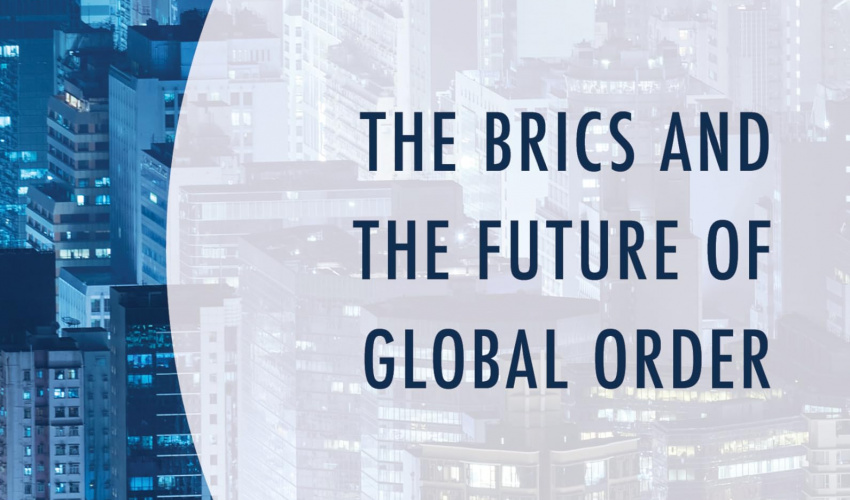
The BRICS and the Future of Global Order
Author: Oliver Stuenkel
Publisher: Oxford University Press / Princeton University Press (distributed by Polity)
Publication Year: 2020
Edition: Second Edition
ISBN: 978-1-108-48941-7
About the Book
The BRICS and the Future of Global Order by Oliver Stuenkel offers a comprehensive and empirically grounded history of how the BRICS grouping—Brazil, Russia, India, China, and South Africa—evolved from a financial acronym into a political alliance that challenges the traditional Western-centered world order. The book serves as both a chronological narrative and an analytical study of the BRICS’ institutionalization, tracing its journey from the early 2000s through the formation of key institutions such as the New Development Bank (NDB) and the Contingency Reserve Arrangement (CRA).
Stuenkel begins by recounting the unlikely transformation of an investment concept into a cornerstone of twenty-first-century international politics. The BRICS, he argues, signify one of the most important innovations in global governance since the creation of the G20. Through annual summits, ministerial meetings, and intergovernmental cooperation, the BRICS have gradually developed into a coordinated bloc, though one marked by deep internal diversity. The book details how these nations—despite their different political systems and economic interests—found common ground in their shared dissatisfaction with Western dominance and their collective ambition to reform international institutions.
The narrative explores key moments such as South Africa’s inclusion in 2010, symbolizing the bloc’s geographic and political expansion, and the 2014 Fortaleza Summit, where the creation of the NDB and CRA underscored the BRICS’ intent to gain greater financial independence. Stuenkel also analyzes how the grouping’s reaction to global crises, including the annexation of Crimea, revealed its potential to act as a counterweight to Western unilateralism.
Throughout the book, Stuenkel presents BRICS as both an idea and an evolving institution, blending rigorous historical detail with sharp geopolitical insight. While acknowledging the internal contradictions—between democracies and authoritarian states, between exporters and importers—he underscores the bloc’s resilience and its symbolic importance in promoting a multipolar global order.
In analytical terms, Stuenkel concludes that BRICS’ significance lies less in its current institutional power and more in what it represents: the decline of Western hegemony and the emergence of plural centers of influence. Rather than replacing the liberal international order, BRICS acts as a corrective force, seeking to reform it from within while redefining what global leadership means in an era of shifting power dynamics.
Contents
Acknowledgments
Introduction
Capturing the Spirit of a Decade (2001–2006)
The Financial Crisis, Contested Legitimacy, and the Genesis
of Intra-BRICS Cooperation (2006–2008)
From Yekaterinburg to Brasília: The New Epicenter of
World Politics? (2009–2010)
Enter South Africa: From BRICs to BRICS (2011)
The Hidden World Of Intra-BRICS Cooperation: Does
Regime Type Matter? 596 Delhi, Durban, and Fortaleza: The New Development Bank
and the Contingency Reserve Agreement (2012–2014)
The BRICS on the UN Security Council: The Case of R2P
The BRICS and the Future of Global Order
Conclusion
Appendix I: High Level Summits
Appendix II: List of All BRICS Meetings
Bibliography


نظر شما :