

Analyzing the Divergence Between Economic Development in Emerging Powers (BRICS) and Rostow’s Theory
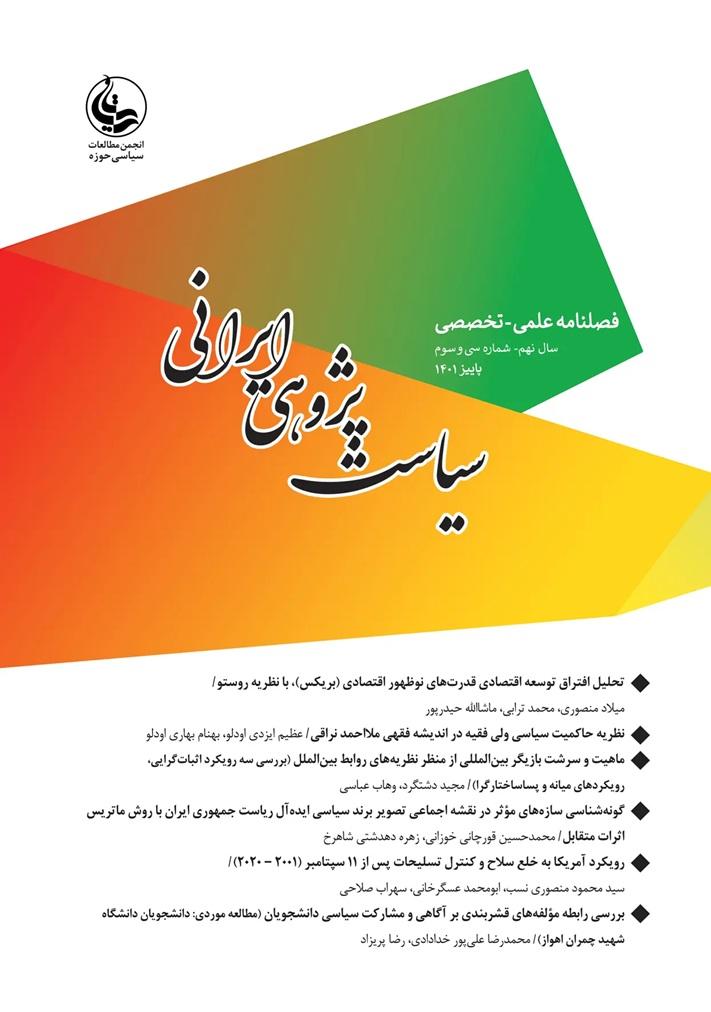
Analyzing the Divergence Between Economic Development in Emerging Powers (BRICS) and Rostow’s Theory
Authors: Milad Mansouri, Mashallah Heydarpour, Mohammad Torabi (corresponding author)
Journal: Iranian Policy Research (Siyasat-Pajouhi-ye Irani)
Issue: 33
Year: Autumn 1401 (2022)
Article introduction
This article analyzes the economic development of BRICS countries by drawing on Rostow’s stages of economic growth. The goal is to identify points of convergence and divergence between BRICS’s development trajectory and Rostow’s linear, Western-oriented model.
The authors show that, despite some similarities, BRICS’s development path differs significantly from Western approaches. Key points of divergence include:
- Systemic transformations and changes in the level of units
- Joint utilization of power resources and shared threats
- Rational decision-making and localization of national and international capacities
- Emphasis on reducing dependence and achieving economic autonomy
The results indicate that BRICS members have successfully completed Rostow’s stages of economic development and transitioned from traditional to modern societies. However, the final stage—mass consumption—has been pursued in a limited and controlled manner due to conservative economic policies and efforts to maintain independence from Western dominance.
This article is useful for those studying emerging development strategies, their comparison with classical growth models, and approaches to reducing dependence on the Western economy.