

The BRICS group: Overview and recent expansion
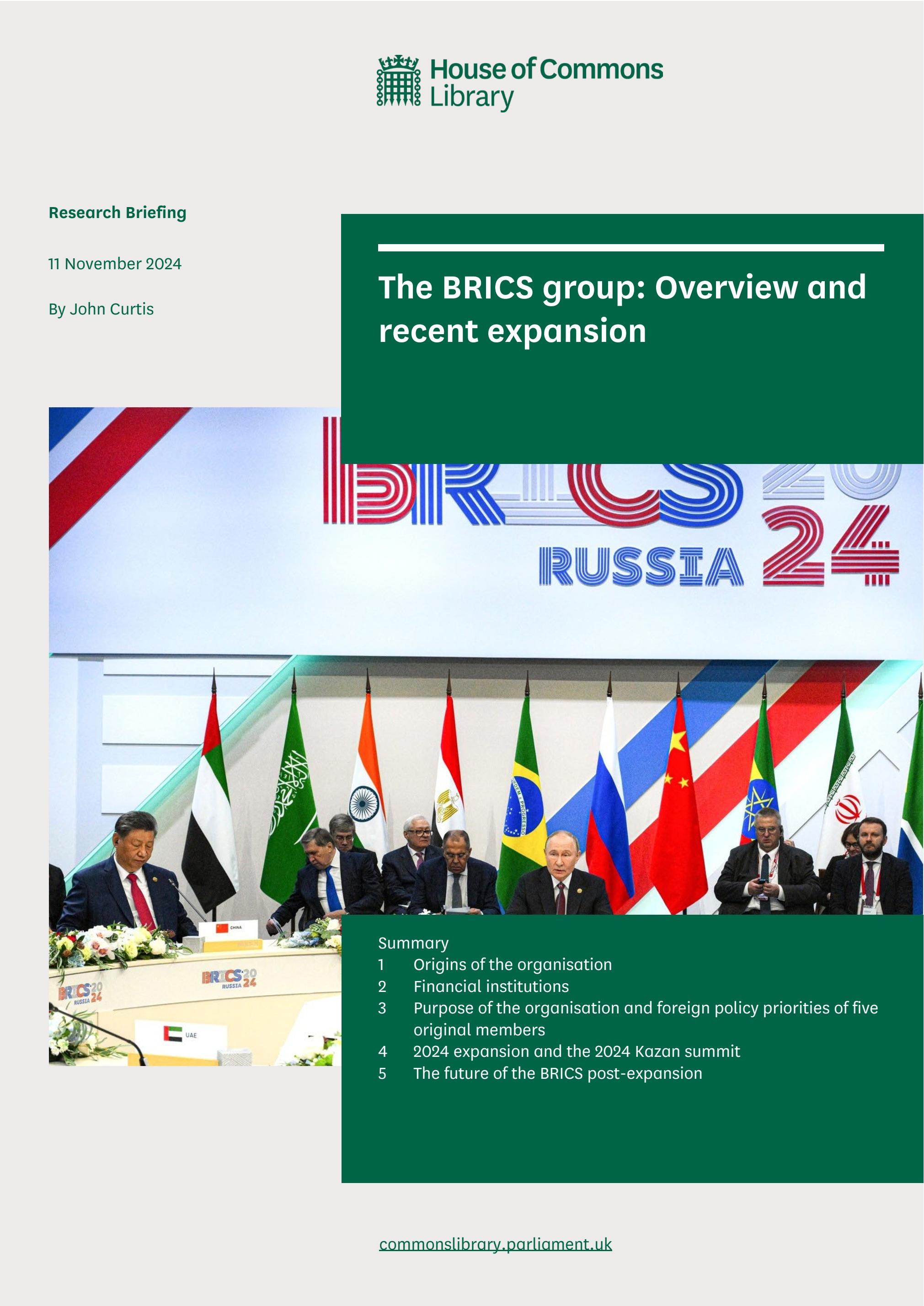
The BRICS group: Overview and recent expansion
Author: John Curtis
Publisher: House of Commons Library (Commons Library Research Briefing)
Publication Date: 11 November 2024
Type: Research Briefing / Policy Analysis
Audience: Members of Parliament (UK), policy analysts, researchers
About This Report
This research briefing provides a comprehensive analysis of the BRICS group—its origins, institutional evolution, 2024 enlargement, and the geopolitical implications of its expanding role in global governance. Originally conceptualised in economic analysis as “BRIC,” the grouping became institutionalised in 2009 when Brazil, Russia, India and China held their first summit. South Africa joined in 2010, formalising the “BRICS.” The report explains how the bloc emerged as a platform to represent major emerging economies seeking a more multipolar international system and reforms to global institutions perceived as dominated by Western powers.
A central focus of the briefing is the 2024 expansion, when Egypt, Ethiopia, Iran and the United Arab Emirates joined the group. While Argentina declined and Saudi Arabia has not yet formally accepted, the enlarged “BRICS+” now represents 45% of the world’s population and 35% of global GDP (PPP). The report discusses the political significance of this enlargement, noting that membership criteria remain flexible, requiring only broad political alignment and consensus among existing members.
The briefing examines key institutional developments, including the creation of the New Development Bank (NDB) and the Contingent Reserve Arrangement (CRA), designed as alternatives to the World Bank and IMF. It also analyzes the priorities of each founding member—Brazil, Russia, India, China and South Africa—highlighting areas of shared interest such as multilateralism, global financial reform, and reduced reliance on the US dollar.
Finally, the report assesses the implications of expansion for the bloc’s future cohesion. While some analysts view the larger BRICS+ as a rising geopolitical force able to accelerate the rebalancing of global power, others warn that internal tensions and diverse foreign policy agendas may hinder coordinated action and reinforce the bloc’s informal, consensus-based character.
Contents
Summary
- Origins of the Organisation
1.1 Origin of the Terms “BRICS” and the Organisation
1.2 Structure
1.3 New Criteria for Membership - Financial Institutions
2.1 New Development Bank (NDB)
2.2 Contingent Reserve Arrangement (CRA)
2.3 Other Potential Financial Initiatives - Purpose of the Organisation and Foreign Policy Priorities of the Five Original Members
3.1 Purpose
3.2 Brazil’s Priorities
3.3 China’s Priorities
3.4 India’s Priorities
3.5 Russia’s Priorities
3.6 South Africa’s Priorities - 2024 Expansion and the 2024 Kazan Summit
4.1 Perspectives of the New BRICS Members
4.2 Potential Future Members
4.3 The 2024 Kazan Summit
The Future of the BRICS Post-Expansion
5.1 Does Expansion Mean More Influence or Less Cohesion?
5.2 Are the BRICS Becoming an “Anti-US” Organisation?