

Higher Education in the BRICS Countries: Investigating the Pact between Higher Education and Society
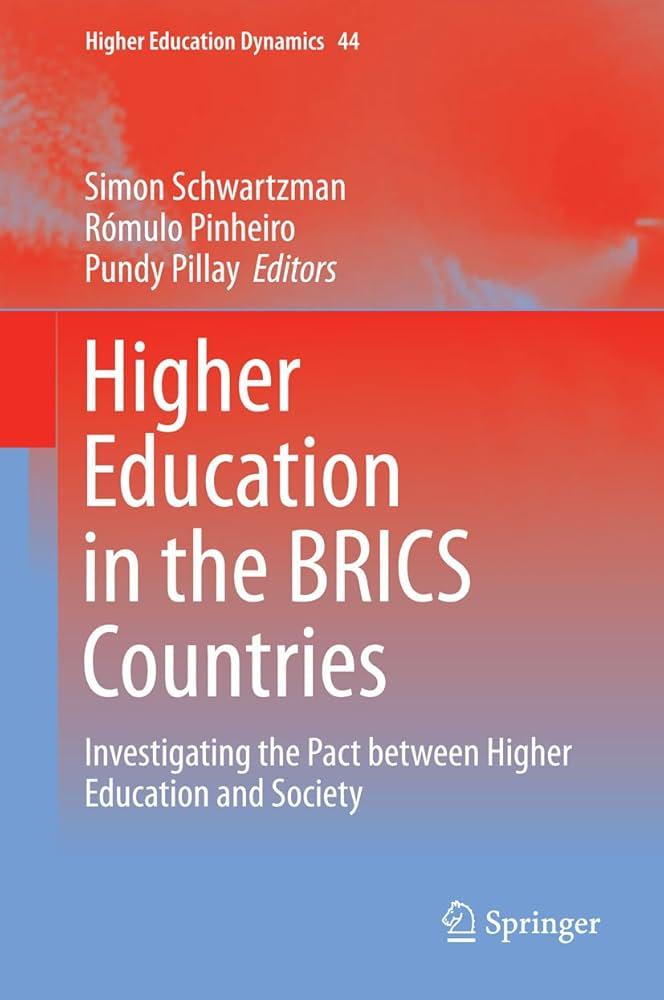
Higher Education in the BRICS Countries: Investigating the Pact between Higher Education and Society
Editors: Simon Schwartzman, Rómulo Pinheiro, Pundy Pillay
Publisher: Springer
Series: Higher Education Dynamics (Vol. 44)
Publication Year: 2015
About this Book
Higher Education in the BRICS Countries provides the first comprehensive comparative study of how higher education systems in Brazil, Russia, India, China, and South Africa have evolved in response to shifting societal expectations and rapid socioeconomic transformation. Rather than treating universities as static institutions designed solely to fulfill state-planned functions, the editors adopt a dynamic perspective: higher education develops through complex interactions among governments, markets, institutional cultures, societal demand, and increasingly, private-sector actors.
The book investigates how each BRICS country interprets the “social pact” between higher education and society—how universities support national development, meet rising demands for access, and balance competing pressures for quality, equity, innovation, and economic relevance. By analyzing supply–demand tensions, stakeholder roles, government policies, and research–innovation linkages, the volume shows how higher education systems adapt unpredictably to internal and external forces.
The comparative approach offers rich conceptual and empirical insights into common challenges—such as massification, quality assurance, inequality, and global competitiveness—while revealing how different historical, political, and cultural contexts shape national responses. For researchers, policymakers, institutional leaders, and students of comparative education, the book provides a nuanced understanding of how higher education contributes to state-building and economic development within emerging major powers.
Ultimately, the volume argues for moving beyond simplistic narratives of universities as uniform actors and instead understanding them as diverse institutions embedded in evolving societal arrangements—arrangements that, in the BRICS context, will profoundly influence global higher education trends in the coming decades.
Contents
1. The Rise of the BRICS and Higher Education Dynamics
Simon Schwartzman, Rómulo Pinheiro, Pundy Pillay
Thematic Summaries
Front Matter
2. Demands and Policies for Higher Education
Simon Schwartzman
3. The Role of Internal and External Stakeholders
Rómulo Pinheiro
4. Linking University Research and Innovation in the BRICS
Creso M. Sá
Supply and Demand
Front Matter
5. Demand and Supply for Higher Education in Brazil
Clarissa Eckert B. Neves
6. Supply and Demand Patterns in Russian Higher Education
Isak Froumin, Yaroslav Kouzminov
7. Higher Education, Social Demand, and Social Equity in India
Kishore M. Joshi
8. Demands and Responses in Chinese Higher Education
Yuzhuo Cai, Fengqiao Yan
9. Supply and Demand in South Africa
Kirti Menon
The Role of Stakeholders
Front Matter
10. The Role of Internal and External Stakeholders in Brazilian Higher Education
Elizabeth Balbachevsky
11. Russian System of Higher Education and Its Stakeholders: Ten Years on the Way to Congruence
Anna Smolentseva, Knyazev Evgeny, Drantusova Natalya
12. Cost Sharing in China’s Higher Education: Analyses of Major Stakeholders
Rui Yang
13. The Role of Stakeholders in the Transformation of the South African Higher Education System
Peliwe Lolwana
Government Policy
Front Matter
14. Higher Education Policies in Brazil: A Case of Failure in Market Regulation
Maria H. de Magalhães Castro
15. The Federal State, Regional Interests, and the Reinvention of Russian Universities
Mark S. Johnson