


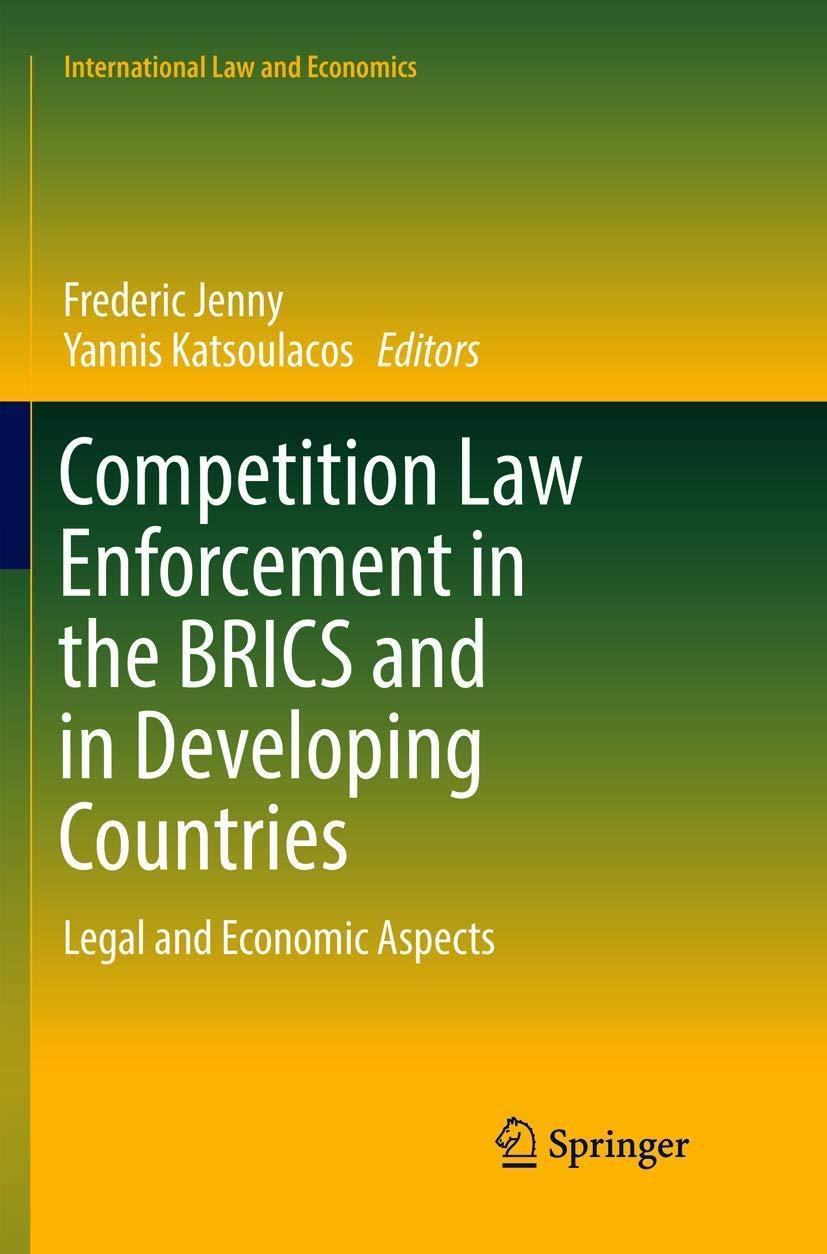
Competition Law Enforcement in the BRICS and in Developing Countries: Legal and Economic Aspects
Competition Law Enforcement in the BRICS and in Developing Countries: Legal and Economic Aspects
Editors: Frederic Jenny, Yannis Katsoulacos
Series: International Law and Economics
Publisher: Springer
Publication Year: 2018
About this Book
Competition Law Enforcement in the BRICS and in Developing Countries provides an in-depth examination of how competition law is designed, enforced, and evaluated in emerging economies, with a particular focus on the BRICS countries: Brazil, Russia, India, China, and South Africa. The volume emphasizes the role of economic analysis and evidence in law enforcement procedures and explores how these tools influence policymaking by competition authorities. Contributors assess institutional frameworks, enforcement performance, procedural fairness, public interest considerations, procurement practices, and compulsory licensing mechanisms.
The book integrates theoretical perspectives with empirical analyses, presenting case studies, country-specific experiences, and comparative assessments. It highlights how competition authorities in these countries confront challenges such as cartel behavior, abuse of dominance, and market monopolies, while balancing the broader public interest. The volume also addresses structural constraints, including limited resources, institutional capacity, and regional disparities, which affect enforcement outcomes. By combining legal, economic, and policy insights, the book offers a nuanced understanding of the opportunities and limitations of competition law in emerging markets. This makes it an essential resource for academics, policymakers, legal practitioners, and economists interested in competition policy and economic governance in developing countries.
Contents
The Institutional Design of Competition Authorities: Debates and Trends
New Indicators of Competition Law and Policy in 2013 for OECD and Non-OECD Countries
Cartel Damages to the Economy: An Assessment for Developing Countries
Public Enforcement of Antitrust Law in China: Perspective of Procedural Fairness
Antitrust and Compulsory Licensing in BRICS and Developing Countries
Procurement Procedures and Bid-Rigging in Brazil
The Nature and Use of Economic Evidence in Competition Enforcement (with Special Emphasis to the Case of South Africa)
Economic Analysis in Antitrust: The Case of Brazil
Economic Evidence in Competition Law Enforcement in India
Models of Monopoly in the Quarter-Century Development of Russian Competition Policy: Understanding Competition Analysis in the Abuse of Dominance Investigations
Economic Analysis in Competition Law Enforcement in Russia: Empirical Evidence Based on Data of Judicial Reviews
The Incorporation of the Public Interest in the Assessment of Prohibited Conduct: A Juggling Act?
Estimating the Benefits of Anti-cartel Interventions: The Case of the South African Cement Cartel
A History of Collusion: The Persistence of Cartels in South Africa
Application of Hypothetical Monopoly Test (SSNIP) to the Brazilian Market of Ready-Made Meals and the Role of the Department of Economic Studies