

Can BRICS De-dollarize the Global Financial System?
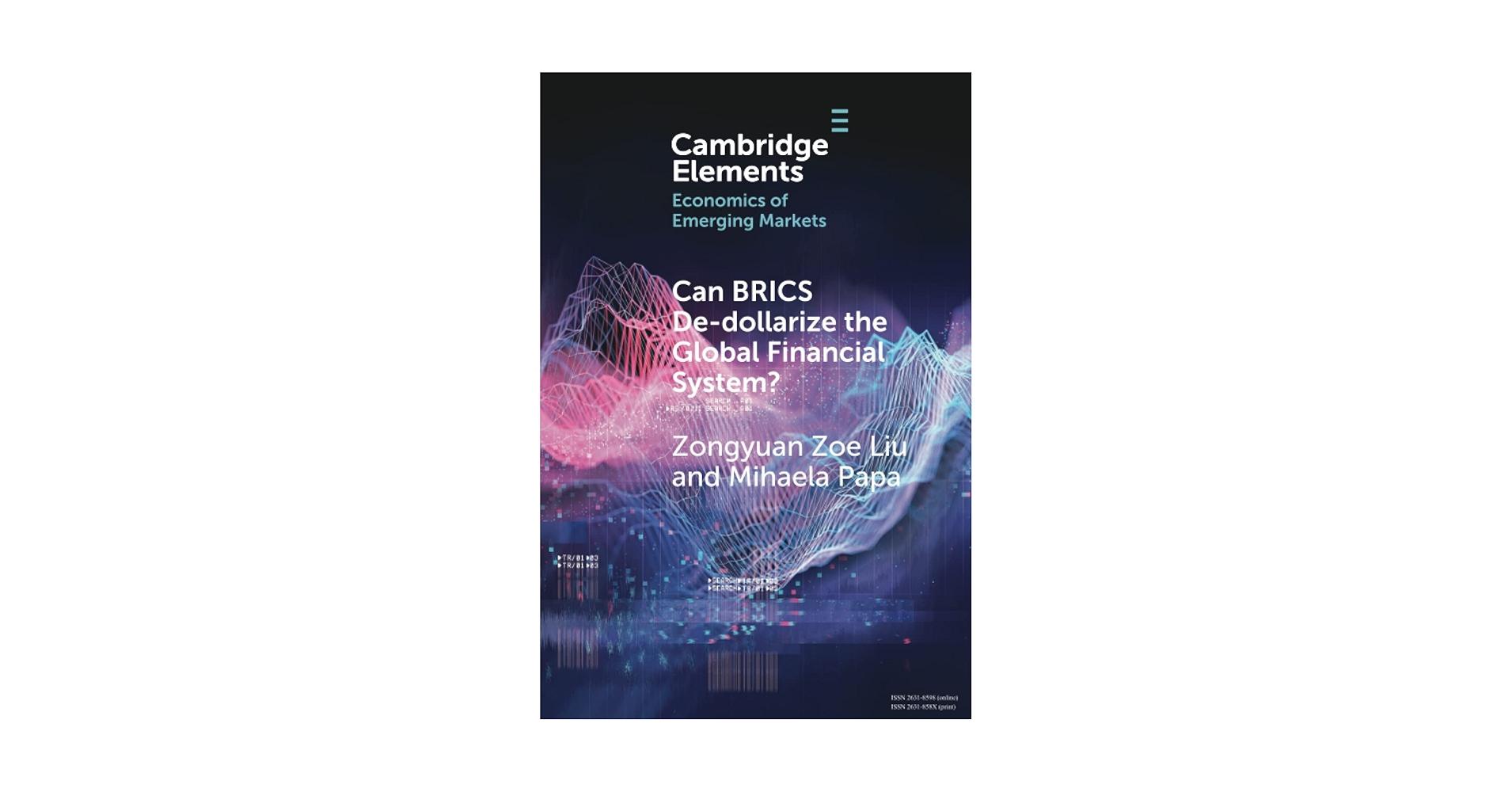
Can BRICS De-dollarize the Global Financial System?
Publisher: Cambridge University Press
Series: Elements in the Economics of Emerging Markets
Publication Year: 2022
About this Book
This study systematically examines whether BRICS (Brazil, Russia, India, China, South Africa) can challenge the US dollar’s dominance and de-dollarize the global financial system. Despite multiple initiatives by BRICS to reduce currency risk, bypass US sanctions, and increase financial autonomy, the group’s collective efforts have remained understudied. The authors introduce a “Pathways to De-dollarization” analytical framework to understand how BRICS countries establish institutions, market mechanisms, and coalitions to reduce dependence on the dollar.
The book highlights two complementary strategies employed by BRICS:
- Go-it-alone initiatives: Establishing alternative institutions and market mechanisms, such as the New Development Bank (NDB), BRICS Pay, cross-border payment systems, and China’s yuan oil futures, aimed at creating a nondollar infrastructure.
- Reform-the-status-quo initiatives: Reforming existing dollar-centric institutions like the IMF, advocating for Special Drawing Rights adjustments, and forming a BRICS stock exchanges alliance.
The study also addresses internal challenges within BRICS, such as divergent member priorities, varying degrees of reliance on the US dollar, and geopolitical constraints that limit the ability to form a fully cohesive de-dollarization coalition. While BRICS has made significant progress in creating the infrastructure for an alternative financial system, a complete departure from the US dollar remains costly and complex.
Overall, the book provides crucial insights into the future of global finance, the potential weakening of US financial hegemony, and the strategic implications of de-dollarization for both BRICS members and global actors. It combines institutional analysis, market data, and qualitative methods, offering a first systematic assessment of BRICS’ de-dollarization activities.
Contents
- Introduction
- A Coalitional De-dollarization Challenge?
- 2.1 An Understudied Issue: De-dollarization through BRICS
- 2.2 The Puzzle: Is BRICS a De-dollarization Coalition?
- 2.3 The Analytical Framework: Pathways to De-dollarization
- 2.4 Research Design
- BRICS as a De-dollarization Coalition
- 3.1 Key Milestones in the Evolution of BRICS as a Financial Coalition
- 3.2 The Gradual Rise of BRICS Currencies
- 3.3 BRICS Members’ Perspectives on De-dollarization
- “Go-It-Alone” Strategy: Establishing New Institutions and Market Mechanisms
- 4.1 The New Development Bank and De-dollarizing Development Finance
- 4.2 The Yuan Oil Futures and De-dollarizing Global Oil Trade
- 4.3 BRICS Alternatives to SWIFT and De-dollarizing Global Financial Infrastructure
- 4.4 BRICS Plus: De-dollarization Mobilization beyond BRICS
- “Reform-the-Status-Quo” Strategy: Remaking Existing Institutions and Markets
- 5.1 Strengthening Self-Defense Against the Dollar’s Dominance
- 5.2 Reforming the Global Reserve Currency Structure
- 5.3 Diffusing the Dollar’s Dominance as the Vehicle Currency in Trade
- 5.4 Disrupting the Dollar’s Dominance in Global Equity Markets
- Conclusion and Implications for Future Research
Acknowledgments
Footnotes
References