

The BRICS Order: Assertive or Complementing the West?
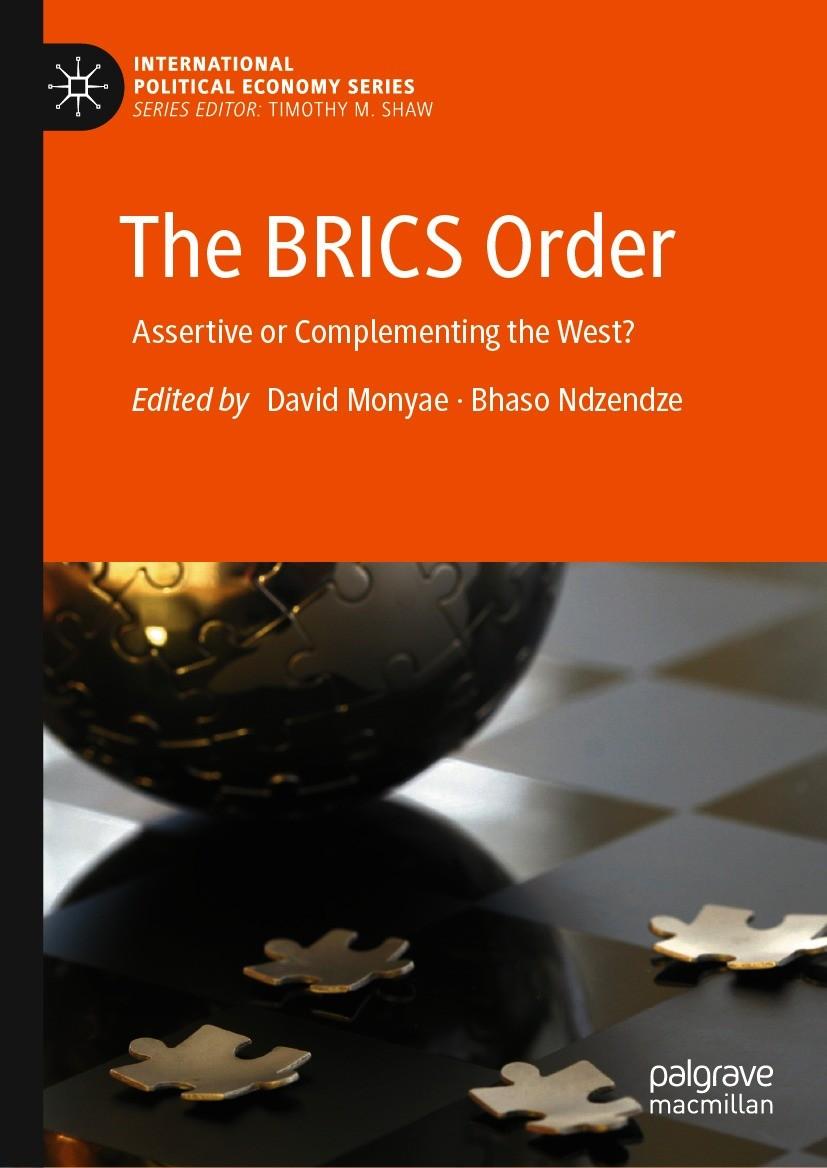
The BRICS Order: Assertive or Complementing the West?
Editors: David Monyae, Bhaso Ndzendze
Series: International Political Economy Series
Publisher: Palgrave Macmillan, Cham
Publication Year: 2021
About this Book
The BRICS Order: Assertive or Complementing the West? offers a comprehensive and deeply analytical examination of the evolution, internal dynamics, and global role of the BRICS grouping—Brazil, Russia, India, China, and South Africa. Edited by David Monyae and Bhaso Ndzendze, this volume investigates whether the BRICS coalition constitutes an emerging challenge to dominant Western-led institutions or whether it ultimately complements the existing global order.
The book begins with foundational historical analysis of the Global South, tracing how the BRICS emerged from shifting geopolitical and economic landscapes after the fragmentation of the post-1945 order. Across its chapters, leading scholars explore key variables shaping the bloc’s trajectory: internal divergences, geopolitical rivalries, governance systems, economic models, and external pressures. Themes include South–South cooperation, Africa–BRICS engagement, industry 4.0 strategies, multilateral institutional reform, the New Development Bank’s evolving role, and the tensions between national interests and collective aspirations.
A central question running through the book is whether the BRICS represents a coherent alternative model or remains primarily a complementary force to Western power structures. Through rich case studies—ranging from China’s development diplomacy to India’s strategic balancing, Brazil’s shifting political landscape, and South Africa’s continental positioning—the volume reveals a spectrum of convergences and contradictions that shape the grouping’s influence.
This book is essential reading for scholars, policymakers, and students of international political economy, global governance, development studies, and foreign policy. It provides a nuanced and multidimensional account of how the BRICS might shape the future of the international order.
Contents
Introduction: The Genealogies, Elements and Implications of a ‘BRICS Order’
Autochthonous Routes to Democracy: Assessing the BRICS Polities
BRICS, Brazil and Africa: Economic Potential and Challenges
Ambiguity or Strategic Play? Distilling India’s BRICS Relations
China, Economic Partnership, Common Development and BRICS
Manna from Heaven! South Africa’s Search for Relevance in the BRICS Constellation
China–India Strains: Whither the BRICS?
BRICS–Africa Cooperation in Perspective: The Case of Kenya
African Perceptions of the BRICS: Optimistic, Pessimistic or Pragmatic?
BRICS and Beyond: Principles of Educational Collaboration in the Global South
The Global South and Industry 4.0: Historical Development and Future Trajectories
BRICS and Industry 4.0
BRICS and FOCAC: Challenging or Supplementing Bretton Woods Institutions?
Conclusion