

Globalization and the BRICs: Why the BRICs Will Not Rule the World For Long
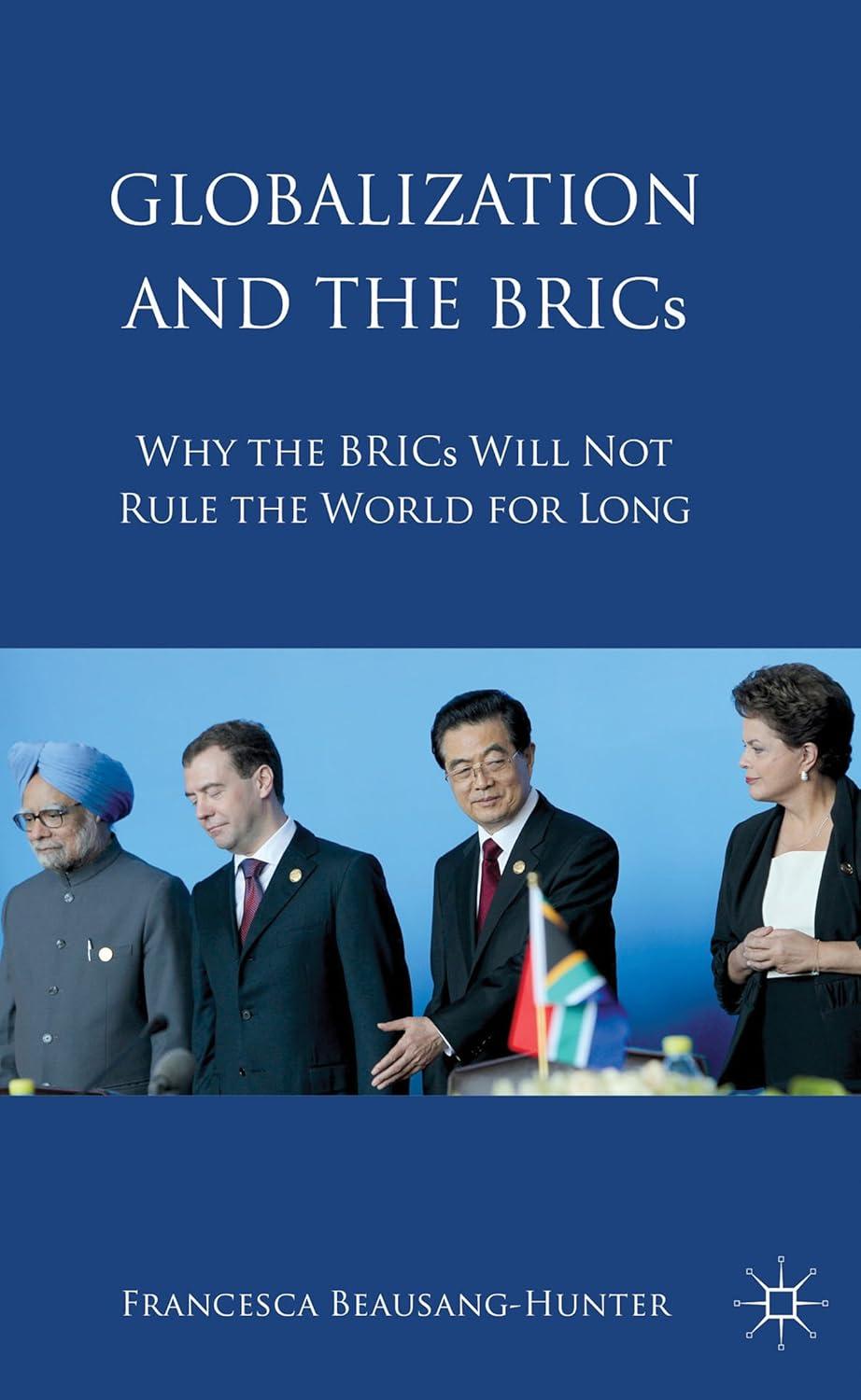
Globalization and the BRICs: Why the BRICs Will Not Rule the World For Long
Author: Francesca Beausang
Publisher: Palgrave Macmillan
Publication Year: 2012
About this Book
Globalization and the BRICs challenges the dominant narrative that Brazil, Russia, India, and China are on an unstoppable trajectory toward global leadership. Written by economist Francesca Beausang, the book provides a rigorous, critical assessment of the structural weaknesses underlying each BRIC country, arguing that their rise is neither guaranteed nor sustainable in the long term. At a time when the Eurozone faces instability and US global influence appears uncertain, Beausang questions the assumption that the BRICs are the inevitable successors to Western economic and political power.
Drawing on insights from development studies, innovation theory, and global political economy, the book identifies two fundamental limitations that threaten the long-term ascent of the BRIC countries:
- Excessive inequality, which undermines social stability, constrains domestic demand, obstructs human development, and weakens the institutional foundations needed for sustained growth.
- Insufficient innovation, particularly the lack of strong knowledge-based sectors, technological dynamism, and policies that promote creativity and intellectual capital.
Beausang systematically analyzes the economic and political power of each BRIC state within the global system and argues that without resolving these deep structural issues, the BRICs are unlikely to achieve or maintain global hegemonic status. Instead, she introduces the innovation-equality-development triangle as a framework for understanding why sustainable power must be built on more than rapid economic expansion.
This book is particularly valuable for scholars and students of development studies, international political economy, global governance, and anyone looking for a critical counter-narrative to the optimistic projections surrounding the BRICs’ future role in world affairs.
Contents
Introduction
BRICs: Beyond Developing?
BRICs and Global Economic Power
BRICs and Global Political Power
Limit No. 1: BRICs and Inequality
Limit No. 2: BRICs and the Silent Power of Ideas
Conclusion: The Innovation–Equality–Development Triangle