

The Political Economy of Intra-BRICS Cooperation - Challenges and Prospects
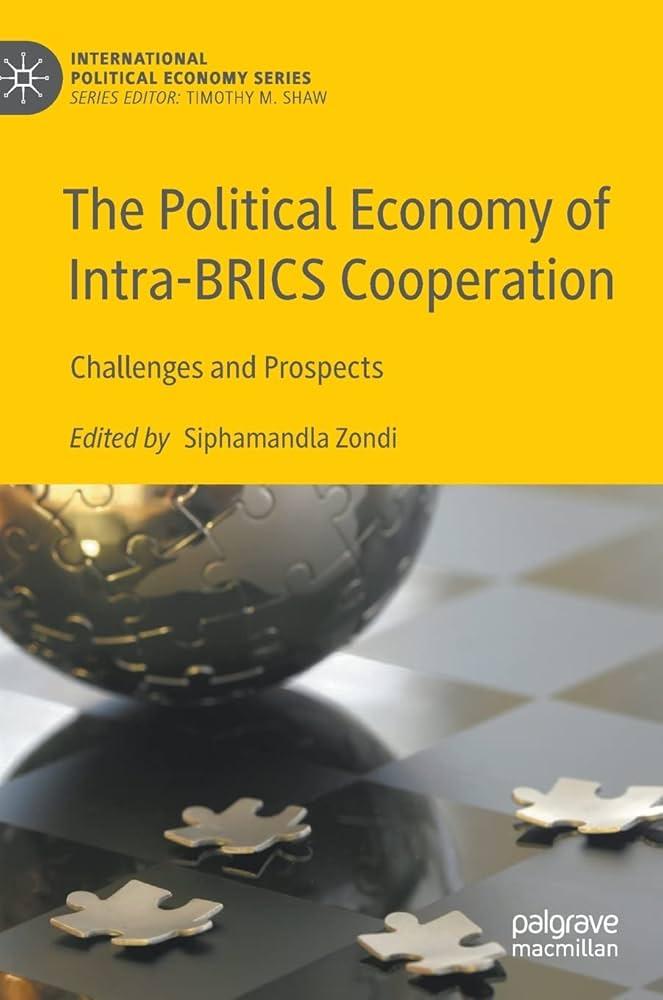
The Political Economy of Intra-BRICS Cooperation - Challenges and Prospects
Editor: Siphamandla Zondi
Series: International Political Economy Series
Publisher: Palgrave Macmillan, Cham
Publication Year: 2022
This book explores the crucial role of intra-BRICS cooperation in ensuring that the bloc achieves its developmental, economic, and political objectives. Edited by Siphamandla Zondi, it argues that for BRICS to maintain credibility and influence in global governance, its member states must strengthen coordination in implementing existing commitments and undertakings. The text emphasizes that without deeper collaboration and functional central institutions, the promises and potential of BRICS could remain unfulfilled.
Covering a wide array of policy areas, the book examines the BRICS Development Bank and its role in financing development projects, opportunities for energy cooperation, and the bloc’s approach to climate change. It also addresses emerging challenges such as transnational crime, competitiveness in the Fourth Industrial Revolution, and digital and technological innovation, highlighting how collaborative approaches can benefit all member states. Special attention is given to social issues, including financial inclusion, women’s empowerment, and equitable development, as well as public health challenges like COVID-19, including intra-BRICS vaccine production frameworks.
By combining theoretical perspectives with practical policy recommendations, the book demonstrates how coordinated action among BRICS nations can enhance accountability, operational efficiency, and sustainable outcomes. It provides policymakers, academics, and students with a comprehensive understanding of how internal cohesion can translate into a more effective and influential BRICS bloc. Ultimately, the volume underscores that deepened intra-BRICS cooperation is essential not only for achieving shared goals but also for shaping the bloc’s future role in global politics and development.
Contents
- Towards Deeper Intra-BRICS Cooperation: An Argument – Siphamandla Zondi, Odilile Ayodele, Siphumelele Duma (pp. 1–15)
- The BRICS Development Bank and Challenges for Development Financing in BRICS—Issues for Consideration – Modimowabarwa Kanyane (pp. 17–38)
- BRICS, Structural Power and the BRICS Bank as a Potentially Progressive Instrument for a Passive Revolution – John Mikatekiso Nelson Kubayi (pp. 39–59)
- Out of the Regime Complex: Practical Options for Enhancing Cooperation in Climate Change and New Frontiers in BRICS – Thulisile Ncamsile Mphambukeli, Victor Ogbonnaya Okorie (pp. 61–77)
- Opportunities and Options for Energy Cooperation Among BRICS Countries – Thokozani Simelane, Jurgen Knop (pp. 79–97)
- BRICS Cooperation in Fighting Transnational Crimes – Nirmala Gopal (pp. 99–113)
- BRICS Countries’ Competitiveness in the 4IR: Findings from Three World Economic Forum Indicators – Bhaso Ndzendze (pp. 115–135)
- No One Left Behind: The Implications of the 4th Industrial Revolution on the Developmental Agenda of the BRICS Countries – Peliwe Lolwana (pp. 137–154)
- Tangible Economic Cooperation for South Africa and the BRICS: Taking Stock and Looking Forward – Cyril Prinsloo (pp. 155–173)
- Financial Inclusion and Women Empowerment in BRICS Countries: Perspectives on India and South Africa – Tinuade Adekunbi Ojo (pp. 175–203)
- COVID-19 and the Counter-Cyclical Responses of the BRICS Countries – Isaac Bheki Khambule (pp. 205–230)
- South Africa’s Vaccine Production Potential: Towards an Intra-BRICS Vaccine Production Framework – Palesa Sekhejane, Vuyo Mjimba (pp. 231–249)
- Towards an Intra-BRICS Implementation and Accountability Framework on Sustainable Development Goals – Siphamandla Zondi (pp. 251–271)