


BRICS and Global Governance
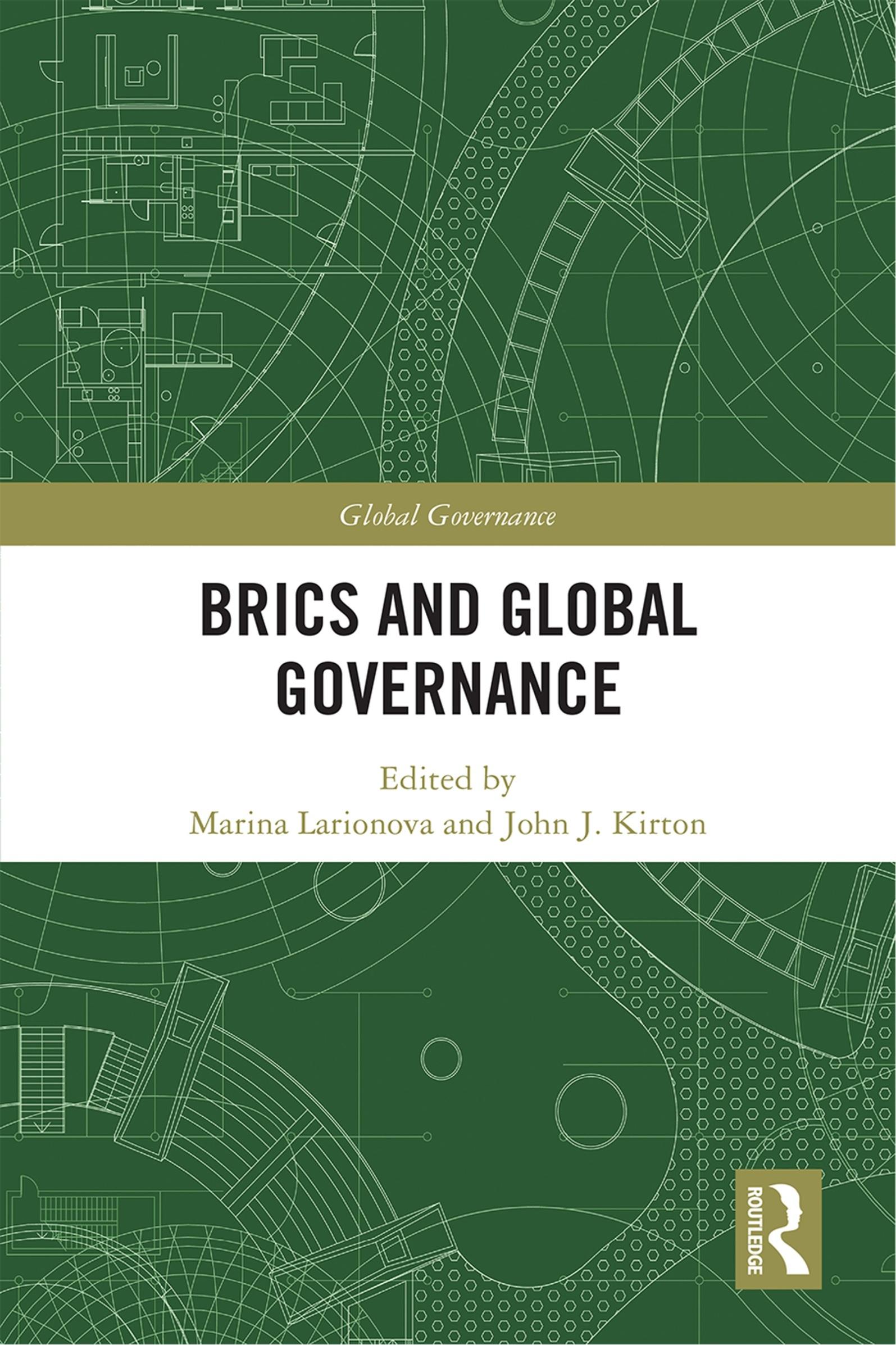
BRICS and Global Governance
Editors: Marina Larionova, John J. Kirton
Publisher: Routledge (Taylor & Francis Group)
Series: Global Governance, Vol. 1
Publication Year: 2018
About the Book
BRICS and Global Governance provides a detailed and multilayered analysis of how the BRICS grouping—Brazil, Russia, India, China, and South Africa—has become a significant actor in shaping contemporary global governance. Since its establishment as a formal summit institution in 2009, BRICS has navigated an international landscape characterized by increasing multipolarity, shifting power balances, and a growing demand for inclusive multilateral cooperation. This volume traces the origins of BRICS, its institutional evolution, and the strategic motivations that drive its members to coordinate policies on issues ranging from economic stability to global security and institutional reform.
The editors and contributors examine how BRICS articulates shared interests despite the considerable political, economic, and cultural differences among its members. They explore the mechanisms the group uses to negotiate internal priorities, develop collective positions, and evaluate compliance with decisions taken at summits. The book also investigates BRICS engagement with established global institutions such as the United Nations, the G20, and the World Trade Organization, highlighting instances where BRICS has sought to reform, supplement, or challenge existing governance structures.
A key contribution of the volume is its balanced critique of both the strengths and limitations of BRICS as an emerging plurilateral platform. It shows how BRICS has contributed to diversifying global governance by offering alternative perspectives on development, democratization of global decision-making, and the rebalancing of international power relations. Through its diverse set of expert authors, the book provides an insightful assessment of BRICS as a durable coalition grounded in shared values, long-term aspirations, and a collective vision for a more equitable world order.
Contents
Part I: Introduction
1 The Rise of New Institutions
Marina Larionova
Part II: The Evolving Institutional Identity of The BRICS
2 Explaining the Solid, Strengthening Success of the BRICS Summit
John J. Kirton
3 BRICS Engagement with International Institutions for Better Governance
Andrey Shelepov
4 Political Dynamics within the BRICS in the Context of Multilayered Global Governance
Maria Raquel Freire
Part III: The BRICS Contribution to Global Governance
5 The New Development Bank in Global Finance and Economic Architecture
Alexandra Morozkina
6 BRICS Financial and Payment Arrangements: A Locus of Intra-Group Trade Development
Natalia Khmelevskaya
7 The BRICS Security Agenda: Russia’s Approach and the Outcomes of the Ufa Summit
Victoria V. Panova
8 BRICS and Non-traditional Security
Niall Duggan
9 Prospects for Cooperation in Science, Technology and Innovation among the BRICS Members
Michael Kahn
Part IV: BRICS Interests and Priorities for Cooperation
10 BRICS for Better Global Governance: A Russian Perspective
Georgy Toloraya
11 The BRICS Agenda in the Asia-Pacific Region
Haibin Niu
12 South Africa in BRICS: Last But Not Least
Vladimir Shubin
13 BRICS Regional Policy in Africa
Tatiana Deych
Part V: Conclusion
14 Looking into the Future of the BRICS
Marina Larionova