

The Political Economy of the BRICS Countries (3 Volumes)
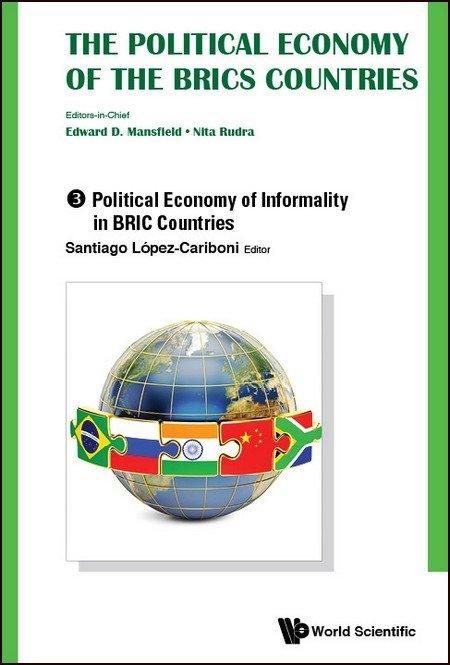
The Political Economy of the BRICS Countries (3 Volumes)
Editor-in-Chief: Edward D. Mansfield (University of Pennsylvania, USA), Nita Rudra (Georgetown University, USA)
Editors: Biju Paul Abraham, Partha Ray, Soo Yeon Kim, Santiago López-Cariboni
Publication Year: 2020
Publisher: World Scientific Books, World Scientific
This three-volume collection explores the political economy of the BRICS nations—Brazil, Russia, India, China, and South Africa—with a focus on inclusive growth, economic governance, and informality. It examines whether the rapid growth in these countries translates into broad-based, equitable social and economic outcomes. The volumes combine comparative analysis, country-specific case studies, and thematic discussions on the role of BRICS in global economic governance, investment, finance, energy, and climate negotiations.
Key insights include:
- BRICS countries do not present a unified set of preferences in global governance, often advancing individual national interests.
- Structural and policy differences among BRICS nations influence their economic performance and ability to coordinate collectively.
- Informality, labor markets, taxation, and service provision are central to understanding political economy dynamics in these countries.
- The rise of BRICS is reshaping international political economy and challenging Western-centric governance models.
The collection is intended for scholars, researchers, policymakers, and graduate students interested in the political economy, development, and international relations of emerging markets, particularly the BRICS nations. It offers a nuanced understanding of the challenges and opportunities associated with inclusive growth, governance, and informality in these major emerging economies.
Contents
Volume 1 – Inclusive Growth and Economic Governance:
- Preface & Introduction
- BRICS: The Political Economy of Non-Inclusive Growth (Biju Paul Abraham)
- Future of BRICS as an Economic Block: Macroeconomic Heterogeneity and Political Mandates (Partha Ray)
- China’s and India’s Economic Performance Post-Financial Crisis (R. Nagaraj)
- Inter-Group Disparities in Growing Economies: India Among the BRICS (Achin Chakraborty & Simantini Mukhopadhyay)
- Inequality and Poverty in India and Brazil Since the 1990s (Sripad Motiram)
- Sustainable Development and BRICS: Unity Amid Diversity? (Anup Sinha)
- Universal Health Coverage and Inclusive Finance in BRICS (Indrani Gupta, Samik Chowdhury, Saibal Ghosh)
- Gender, Education, and Programma Bolsa Familia in Brazil (Aparajita Gangopadhyay)
Volume 2 – BRICS and the Global Economy:
- Country Perspectives on Global Governance: Brazil, Russia, India, China, South Africa
- Regionalism and Foreign Aid: BRICS as Emerging and Regional Powers
- Investment, Finance, and Exchange Rate Policies in BRICS
- Climate Negotiations, Energy Security, and Global Energy Governance
- Representation, Fragmentation, and Legitimacy in International Financial Institutions
Volume 3 – Political Economy of Informality in BRICS:
- Introduction: Approaches to Informality (Santiago López-Cariboni)
- Tax Revenue, Globalization, and Informality in BRICS
- Informal Settlements and Provision of Public Services
- Labor Market Informality, Political Mobilization, and Policy Preferences
- Conclusions: Lessons from Informality in BRICS Countries