

BRICS Media: Reshaping the Global Communication Order?
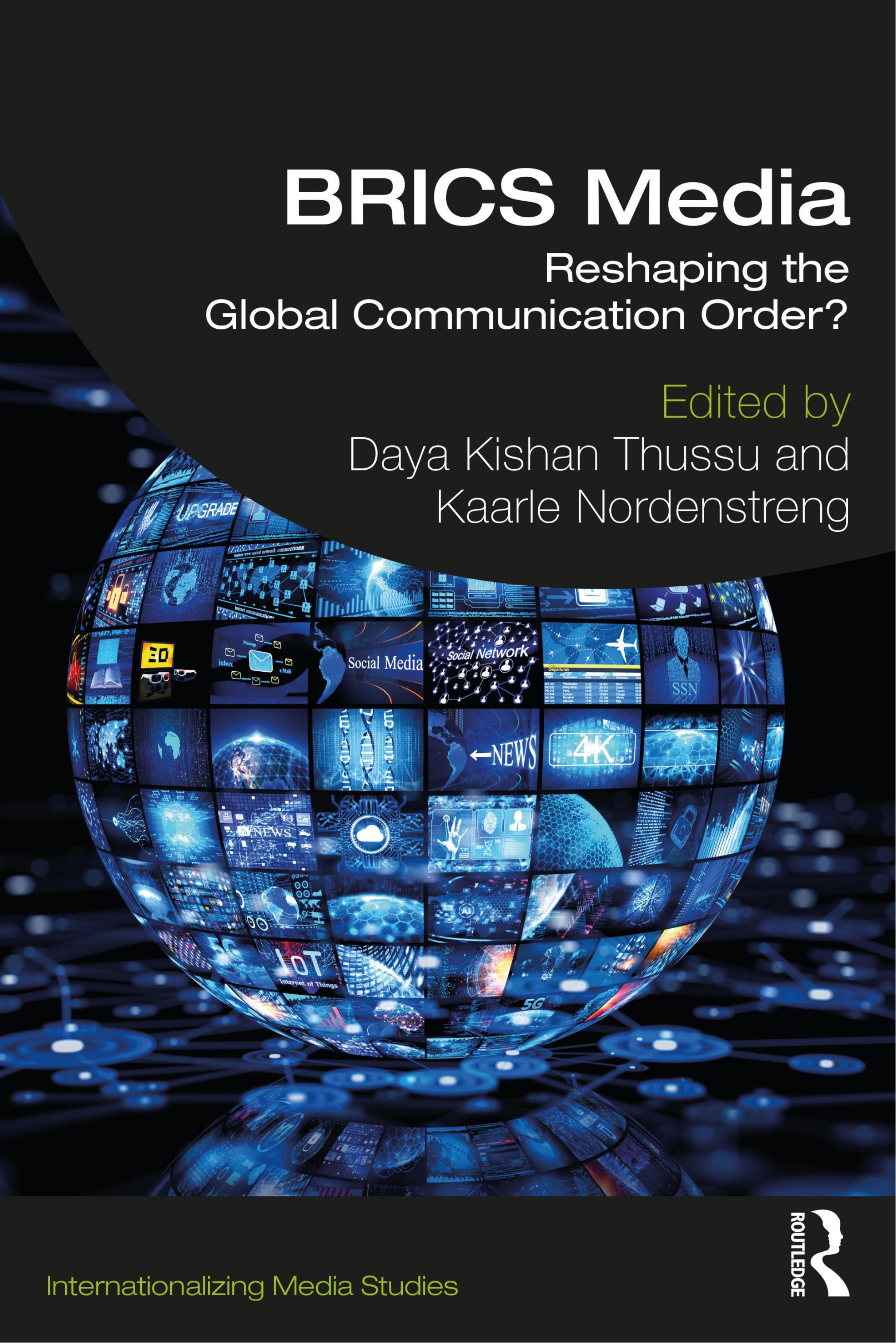
BRICS Media: Reshaping the Global Communication Order?
Editors: Daya Kishan Thussu, Kaarle Nordenstreng
Edition: 1st Edition
Publication Year: 2020
Publisher: Routledge
This edited volume examines the role of BRICS nations—Brazil, Russia, India, China, and South Africa—in reshaping global communication structures in the twenty-first century. Bringing together leading scholars from BRICS countries and beyond, the book explores the expansion of online and mobile media in these emerging powers and their implications for international media flows, soft power, and global communication practices. By adopting a critical approach, the contributors analyze how BRICS countries are challenging traditional Western-centric communication hegemony, fostering a more polycentric and pluralistic global mediascape. The volume highlights the diversity of national strategies, the convergence of digital technologies, and the complex interplay of regional and global influences. Its interdisciplinary perspective makes it an essential resource for students and researchers in journalism, media studies, international relations, politics, and cultural studies.
The book emphasizes the transformative potential of BRICS media, demonstrating how emerging powers are redefining global communication norms. By critically assessing both cooperation and competition among BRICS nations, it provides a nuanced understanding of the interplay between media, technology, and geopolitics in shaping a post-Western global order.
Contents
Foreword: Understanding Global Communication in a Polycentric World
Barry K. Gills
Introduction
Daya Kishan Thussu and Kaarle Nordenstreng
Part I –Challenging Dominant Discourses in a New World Order
Chapter 1 The BRICS paradox
Marko Juutinen and Jyrki Käkönen
Chapter 2 Shifting paradigms in communication research
Muniz Sodré, Raquel Paiva, Kaarle Nordenstreng and Leonardo Custódio
Chapter 3 Moving beyond Western models in the study of BRICS media systems
Savyasaachi Jain
Part II – Media and Communication Structures and Systems
Chapter 4 Th Brazilian media system in a turbulent environment
Fernando Oliveira Paulino and Liziane Guazina
Chapter 5 A post-analogue hybrid media system: the Russian case
Elena Vartanova
Chapter 6 Media systems and structures in India
B. P. Sanjay
Chapter 7 Beyond convergence: rethinking China’s media system in a global context
Zhengrong Hu, Deqiang Ji, Peixi Xu and Kriti Bhuju
Chapter 8 South Africa: Beyond democratic deficit in public service broadcasting
viola milton and Winston Mano
Part III – BRICS and Global Strategic Communication
Chapter 9 Brazil and corporatist soft power
Joseph Straubhaar
Chapter 10 Russian soft power from the USSR to Putin’s Russia
Dmitry Gavra and Elena Bykova
Chapter 11 India: culture as soft power
Daya Kishan Thussu
Chapter 12 China’s cultural power reconnects with the world
Ying Zhu and Michael Keane
Chapter 13 Contending soft powers: South African media on the African continent
Herman Wasserman and Musawenkosi Ndlovu
Part IV – BRICS and Changing Communication Practices
Chapter 14 BRICS journalism as a new territory for localizing journalism studies
Jyotika Ramaprasad and Svetlana Pasti
Chapter 15 Neoliberal capitalism and BRICS on screen
Tatu Laukkanen and Iiris Ruoho
Chapter 16 BRICS de-Americanizing the Internet?
Daya Kishan Thussu