

The BRICS+ and Gulf Cooperation Council Countries: Public Policies, Foreign Policy and Geopolitics
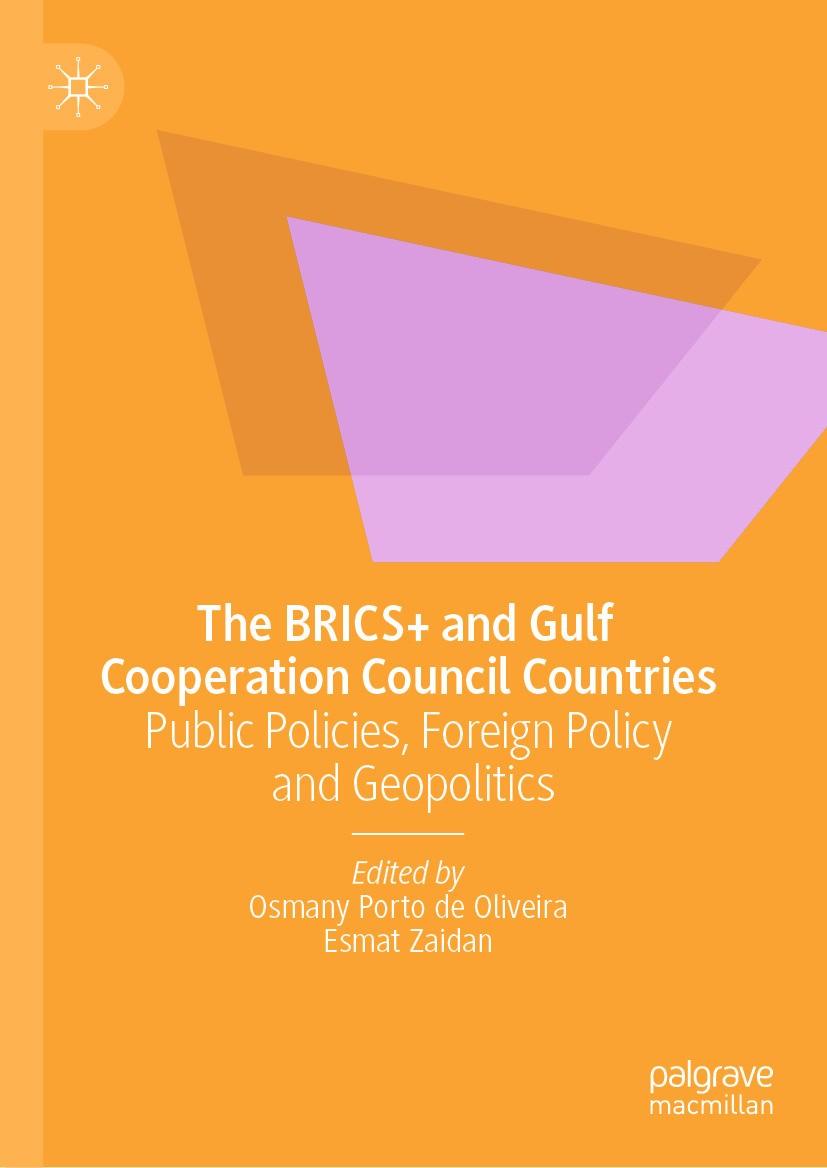
The BRICS+ and Gulf Cooperation Council Countries: Public Policies, Foreign Policy and Geopolitics
Editors: Osmany Porto de Oliveira, Esmat Zaidan
Publisher: Springer Nature Switzerland
Publication Year: 2025
About the Book
This edited volume, overseen by Osmany Porto de Oliveira and Esmat Zaidan, provides a comprehensive and timely examination of the evolving relationships between the BRICS+ coalition and the Gulf Cooperation Council (GCC) countries. By expanding the traditional BRICS grouping to include key Gulf states, the book highlights a significant shift in global geopolitics, reflecting the growing influence of the Global South in shaping international norms, economic partnerships, and diplomatic coordination.
The book explores multiple dimensions of BRICS+ and GCC cooperation, focusing on interregionalism, policy exchange, economic collaboration, and the strategic implications of these interactions. It traces the historical evolution of BRICS from a loose coalition of emerging powers to a more institutionalized entity, complete with its own think tank network and policy coordination mechanisms. This institutional growth is contextualized within ongoing geopolitical developments, including the war in Ukraine and shifting alliances in the Middle East, offering a lens through which to assess both opportunities and challenges in regional and global governance.
A recurring theme throughout the book is the strategic positioning of key members. For instance, chapters on Russia and China explore how these major powers leverage their roles within BRICS+ to advance national interests while supporting broader interregional cooperation. Russia’s deepening engagement with the Gulf states demonstrates a pragmatic approach to multilateral diplomacy and economic exchange despite Western sanctions, while China’s policy experimentation framework offers insights into the interplay between domestic strategies and foreign policy within the expanded BRICS+ network.
The inclusion of the UAE and the prospective entry of Saudi Arabia are examined in depth, emphasizing the geopolitical and geo-economic rationales for joining the bloc. These chapters illustrate how BRICS+ membership serves as a platform for pursuing both hard power objectives—such as energy and trade partnerships—and soft power strategies, including cultural diplomacy and multilateral visibility. Brazil’s interactions with the GCC are similarly highlighted, offering comparative perspectives on interregional engagement and policy diplomacy across the Global South.
Overall, the book situates the BRICS+ and GCC countries as critical players in shaping a multipolar world order. It addresses the complexities of interregionalism, strategic partnerships, and public policy coordination while providing a forward-looking perspective on how these countries might influence the evolving global governance landscape. This volume is an essential resource for scholars, policymakers, and practitioners interested in international relations, global governance, and the strategic dynamics of emerging powers.
Contents
- Introduction: Analyzing the BRICS+ and Gulf Cooperation Council Countries – Osmany Porto de Oliveira, Esmat Zaidan (Pages 1-25)
- Building a Cohesive Global Order: Promoting Interregionalism Between GCC and BRICS+ – Hong Liu
- Russian Pivot to the South: Moscow’s Strategic Interests in the Arab Gulf Amid War in Ukraine and the BRICS Expansion – Chiara Lovotti
- Understanding China in the BRICS+: From Domestic to Foreign Policy Experimentation – Mingchun Xu, Emma Mawdsley
- Saudi and UAE Paths to BRICS: The Impact of Their Relations with Russia – Diana Galeeva
- Diplomacy and Public Policies in the BRICS+ and GCC Countries: Perspectives from Brazil – Osmany Porto de Oliveira, Amanda do Lago Pauletti Domingues, Rebecca Gutierrez
- So the UAE Joined the BRICS…Well, Why Not? – Vânia Carvalho-Pinto
- The Gulf Cooperation Council and Its Member States as Inter-Regional Economic Players – Charalampos Giannakopoulos, Georgios Dimitropoulos
Conclusion: What Have We Learned About the BRICS+ and GCC Countries and Where Should We Go from Here? – Esmat Zaidan, Osmany Porto de Oliveira