

COVID-19 and Climate Change in BRICS Nations: Beyond the Paris Agreement and Agenda 2030
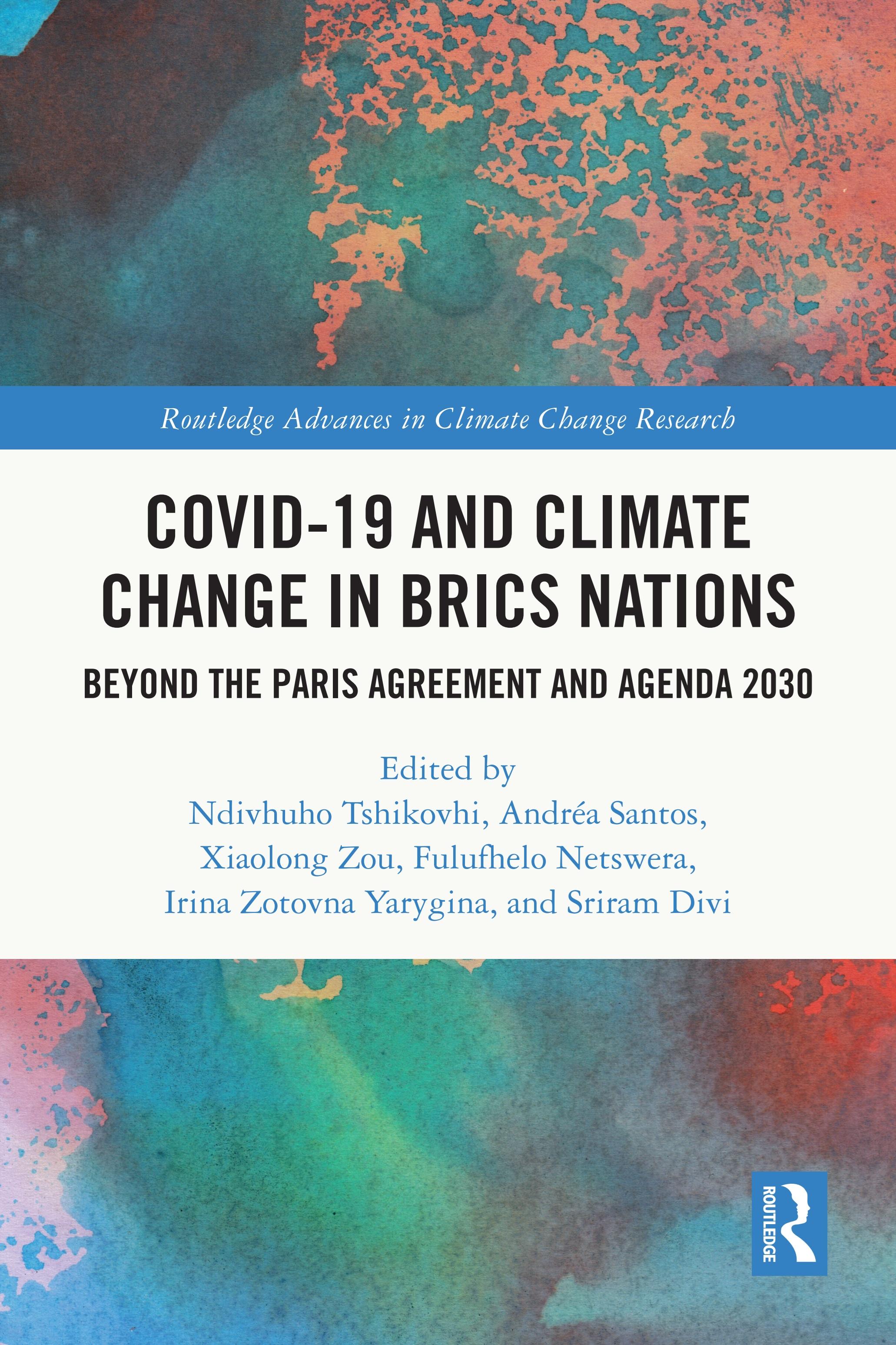
COVID-19 and Climate Change in BRICS Nations: Beyond the Paris Agreement and Agenda 2030
Editors: Ndivhuho Tshikovhi, Andréa Santos, Xiaolong Zou, Fulufhelo Netswera, Irina Zotovna Yarygina, Sriram Divi
Author: Xiaolong Zou
Publisher: Taylor & Francis
Edition: 1st Edition
Publication Year: 2023
About the Book
COVID-19 and Climate Change in BRICS Nations: Beyond the Paris Agreement and Agenda 2030 offers an in-depth, multidisciplinary analysis of how the COVID-19 pandemic has reshaped the climate governance strategies of Brazil, Russia, India, China, and South Africa. Edited by leading scholars and policymakers, this volume investigates the intersections between health crises, climate policies, and sustainable development goals in emerging economies that collectively represent nearly 40% of the world’s population.
The book brings together a combination of quantitative and qualitative approaches, exploring how pandemic disruptions affected the pace, capacity, and structure of BRICS climate actions. Each chapter uses case studies to analyze the national and regional effects of COVID-19 on energy transitions, urban governance, environmental financing, and global cooperation frameworks such as the Paris Agreement and the UN’s Agenda 2030.
In Part I, the contributors examine how the pandemic delayed or redirected national climate strategies. The opening chapter, by Yichen Hao, explores the profound influence of COVID-19 on BRICS climate strategies and calls for stronger collaborative frameworks to address shared challenges. Subsequent chapters analyze Brazil’s potential for a post-pandemic green industrial revolution (Jaciele Davi Neto) and Russia’s continued commitment to environmentalism amid economic and geopolitical crises (Irina Zotovna Yarygina).
Part II turns to sustainable initiatives aligned with Agenda 2030. Chapters explore the interrelation between greenhouse gas reduction and socioeconomic development across BRICS nations (Ilya Stepanov et al.), the impact of climate change on Brazil’s road infrastructure (Andréa Souza Santos et al.), India’s evolving energy transition strategies (Jing Wang), and urban climate governance in China’s Shenyang city (Xiaolong Zou & Lemeng Yu). These case studies demonstrate that while each BRICS nation faces unique constraints, shared priorities—such as reducing emissions, integrating sustainability into infrastructure, and managing energy transitions—create fertile ground for cooperative innovation.
Part III addresses the geopolitical and structural dynamics of climate action in BRICS countries. Letian Xie and Yilin Quan examine BRICS’ evolving role in global climate governance, arguing that the bloc is shifting from participation to leadership in international negotiations. Zou and Qi Shen explore China’s energy security and transition challenges, while Simiso Fisokuhle Nyandeni discusses the implications of population dynamics for environmental sustainability. Manoj K. Sahoo evaluates India’s post-COVID best practices in green recovery, emphasizing the convergence between climate resilience and pandemic preparedness. The concluding chapter, by Aifani Confidence Tahulela, Ndivhuho Tshikovhi, and Fulufhelo Netswera, assesses sustainability pathways beyond COP26, emphasizing the need for enhanced cooperation, technology transfer, and inclusive governance to advance global environmental goals.
This book underscores a central theme: that the COVID-19 pandemic, far from being a purely health-related crisis, has accelerated the urgency of integrating climate and development agendas. The BRICS nations, with their diverse economic models and environmental challenges, play a pivotal role in shaping the next phase of global sustainability governance.
From a policy perspective, the editors advocate for green recovery frameworks, the institutionalization of green finance, and the creation of climate data platforms to monitor progress and transparency. The analysis calls for a redefinition of development priorities—transforming crisis into opportunity through innovation, resilience, and cooperative climate diplomacy.
COVID-19 and Climate Change in BRICS Nations is a valuable resource for scholars, policymakers, and students in environmental politics, climate policy, and global development studies. It captures the complexity of balancing economic growth with ecological responsibility in a post-pandemic world.
Contents
List of Figures
List of Tables
List of Contributors
Part I: COVID-19 Delaying the BRICS Nations’ Climate Strategy Goals
- The Impacts of the COVID-19 Pandemic on BRICS’ Climate Strategies and the Potential Solutions — Yichen Hao
- Brazil in the Post-COVID Era with Potential to Accelerate a Fourth Green Industrial Revolution — Jaciele Davi Neto
- Post-pandemic Russia and its Continued Commitment Towards Environmentalism — Irina Zotovna Yarygina
Part II: Sustainable Initiatives and Strategies of BRICS Countries for the Agenda 2030
4. Climate Policies in the BRICS Countries: The Interrelation between GHG Emissions Reduction and Socio-Economic Development — Ilya Stepanov, Igor Makarov, Anna Shuranova, Daria Serova, Kamila Salakhova, Yana Kubrakova, Alexander Burlakov
5. Implications of Climate Change for the Brazilian Road Infrastructure — Andréa Souza Santos, Victor Hugo Souza de Abreu, Gabriel Bezerra Costa de Lima, Thaís Guedes Máximo Monteiro
6. India's Strategy for Climate Change and Energy Transition — Jing Wang
7. Climate Change and Cities in China: Impacts, Drivers and Policies in Shenyang City — Xiaolong Zou, Lemeng Yu
Part III: The Climate Change Issues and Solutions Dynamics in BRICS
8. The Process, Role, and Future of BRICS Participating in Global Climate Governance — Letian Xie, Yilin Quan
9. China’s Energy Security and Transition in the Post-Paris Era — Xiaolong Zou, Qi Shen
10. The Implication of Population Dynamics on Environmental Issues: A Case Behind Global Change in Climate — Simiso Fisokuhle Nyandeni
11. COVID-19 Pandemic and its Impact on Climate Change and Environment: An Analysis of Best Practices and Initiatives from India — Manoj K. Sahoo
12. BRICS and Global Environmental Cooperation – An Assessment of Sustainability Pathways Beyond COP26 — Aifani Confidence Tahulela, Ndivhuho Tshikovhi, Fulufhelo Netswera
Index